Cicada: The Metro Gallery
Ku Romillo (2025)
Cicadas spend most of their lives underground, silent, unseen. Eventually, they come up, shedding a shell that remained intact long after they’ve flown. For a brief season, they fill the air with a sound both overwhelming and instinctual. Some call it singing. Others call it a warning.
That’s the territory Ku Romillo’s new series of work moves through. It occurs in the small pause before that compulsion – not on the spectacle of transformation but in its inevitability. The paintings repeat figures so rhythmic it becomes a kind of mental tinnitus, provoking viewers to feel the same psychological recursion the artist describes: the way a painful memory becomes its own refrain; the way doubt echoes louder than reason; the way the mind rehearses its own demise with the devotion of a ritual.
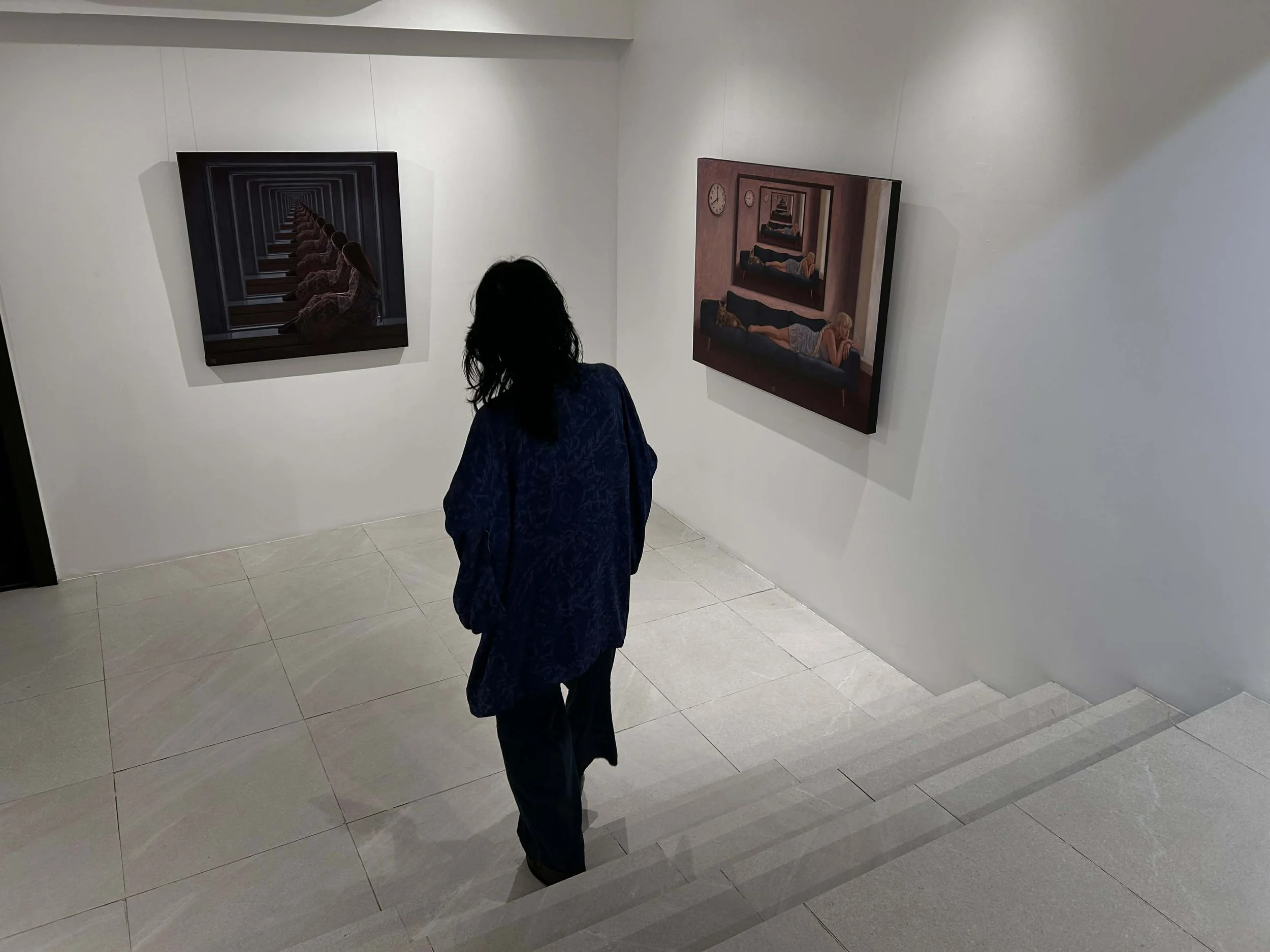
In Kenosis, the subject presents herself in regression, each smaller figure nested inside the last. It reads as a study on both collapse and archive, of how a person becomes smaller under the weight of being seen to present a legible version of themselves. Graviton moves this crisis into the domestic sphere, where its quiet looping explores how a single moment can generate its own internal gravity. Nothing happens, yet stillness grows dense, and the mirror holds the last thought without explanation. Limen marks the moment when the edge appears, but the body stays still. As the subject reaches towards her own reducing figures, the distance remains constant. You think at first, she might reach herself but in reality, thresholds deceive, and often, you cross them only in hindsight.
Memory, as Romillo presents it in this collection, isn’t the repository we pretend it is. It is a rehearsal. In Anamnesis, she turns it into a soft, endless recitation. Each figure remembers the previous one imperfectly, which is how remembering works: you make a copy of a copy and call it truth. Rumination presents how the recursive mind is in full view. The seated figure, multiplied to infinity, appears calm, but the repetition is relentless. If you follow the corridor far enough, the figure becomes a vanishing point. If you follow it further, the vanishing point becomes you.
In Exuviae, she approaches this cycle not as catharsis but as excess. In the natural world, exuviae is the shell an insect leaves behind after molting: a perfect, empty record. Here, the husks are internal. Personal, certainly, but porous – shaped by our own circumstances, by others’ expectations, and by the silent violences the society requires us to endure. What stays with the viewers after moving through each painting is how little is resolved and how much accumulates. Romillo’s thought process moves inside this tender circling: that life changes only when the pressure surpasses what the body can continue to hold. Still, she does not resolve this pressure. She names it.
In reality, survival looks like this: a multitude of selves, each one trying in its own limited way, to go on. Thus, these are less concerned with the triumphs but rather, more with the intervals between each of our attempts. Those long hours inside a returning thought and the insistence of a mind learning, again and again – that control is a fiction we give ourselves to make living bearable. “I contain multitudes” is a line people often quote for comfort, as if plurality were a consolation. In this series of work, the artist embodies this very evidence, neither escaping nor collapsing under it.
Romillo’s body of work has always centered on personal narratives layered with universal themes of identity, myth, and transformation. But more than her virtuosic use of allegorical elements to evoke meaning into these works, each painting holds a story as mundane, raw, and human as it appears. She offers no resolution. She simply invites you in.
Curatorial Text by Chan Alvarez