id - selected group exhibition
Makati City, Philippines
21-27 February 2026
1159 Creative Space
The question of identity remains one of the most contested sites of contemporary artistic practice. No longer confined to essentialist definitions, identity today does not emerge in a vacuum. It is produced within histories — of colonial encounter, migration, labor, survival, memory, and cultural negotiation. Yet before identity is codified into social categories, before it is stabilized by language, representation, or ideology, there exists a more unstable register of subjectivity: what Freud theorized as the id — the psychic domain of instinct, impulse, repression, and desire (The Ego and the Id, 1923).
This exhibition situates itself within that charged terrain: the intersection of subconscious formation and cultural inheritance.
The participating artists share a common heritage and ethnicity, but the exhibition resists any reductive notion of identity as fixed essence. Instead, it examines identity as a dynamic process — historically conditioned, psychologically mediated, and visually constructed. As Stuart Hall reminds us, cultural identity is not an archaeological recovery of origins but “a positioning” — continuously constructed within representation (Cultural Identity and Diaspora, 1990).
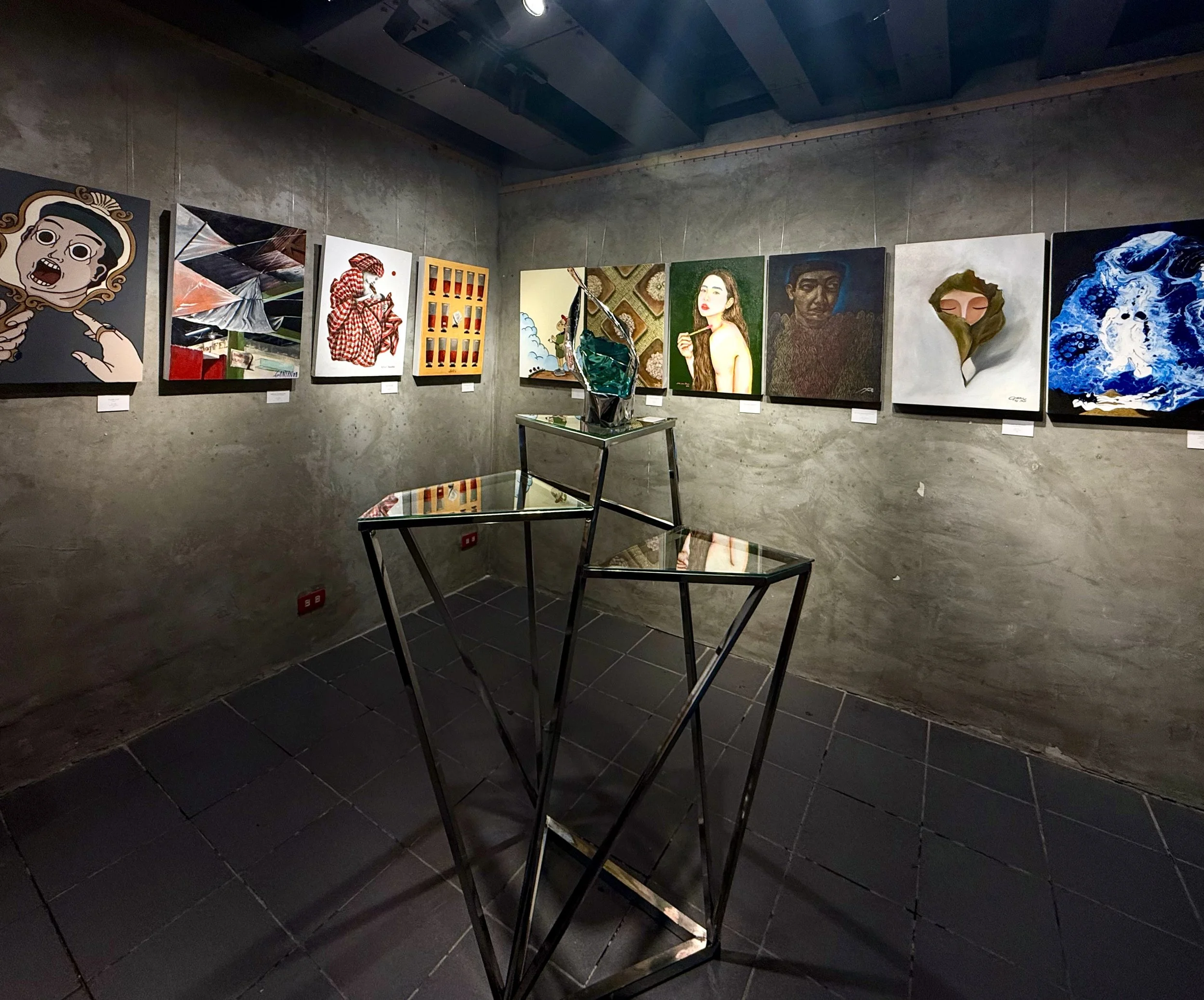
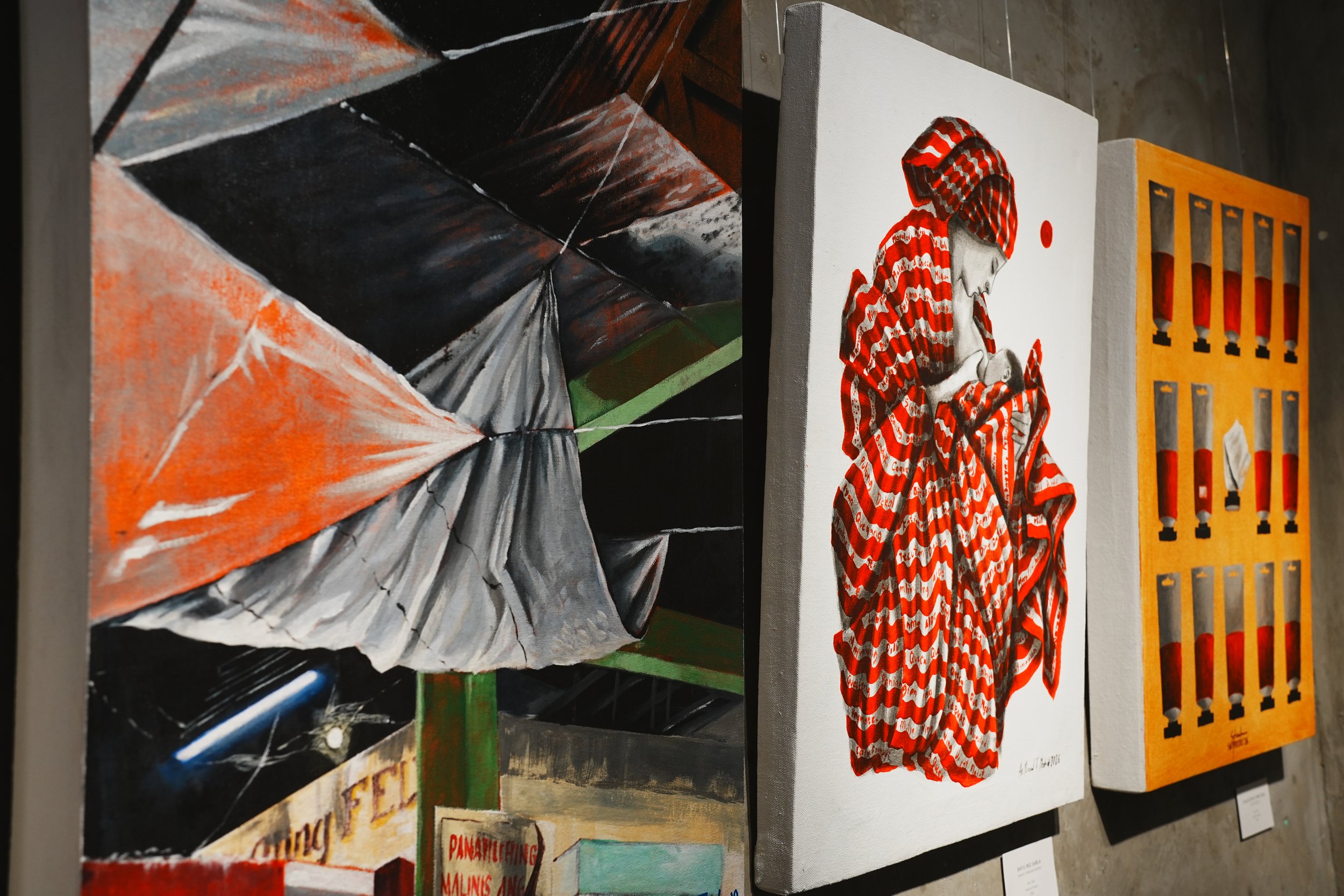
Across the works presented, we encounter a visual field structured by encounters with memory embedded in the everyday. Street intersections, market stalls, temporary shelters — these sites of ordinary experience emerge as spaces structured by economic realities, social relations, and collective histories. They reflect what Henri Lefebvre described as the social production of space (The Production of Space, 1974): environments where lived experience, power, and ideology converge.
Objects of daily existence — umbrellas, woven mats, garments, food — recur as symbolic forms. Their repetition suggests what Pierre Bourdieu might describe as habitus: the internalization of cultural structures within bodily dispositions (Outline of a Theory of Practice, 1972). These motifs are not decorative ethnographic references but rather, are carriers of accumulated histories. Thus within this works, the body becomes a central axis of interpretation.
Bodies that carry.
Bodies that nurture.
Bodies that endure.
Here, identity is articulated through gesture rather than proclamation. These images recall Frantz Fanon’s insights into the lived body as the terrain upon which history, race, and subjectivity are inscribed (Black Skin, White Masks, 1952). Yet the exhibition moves beyond trauma-centered readings:
It foregrounds who we are before logic, language, and social structure.
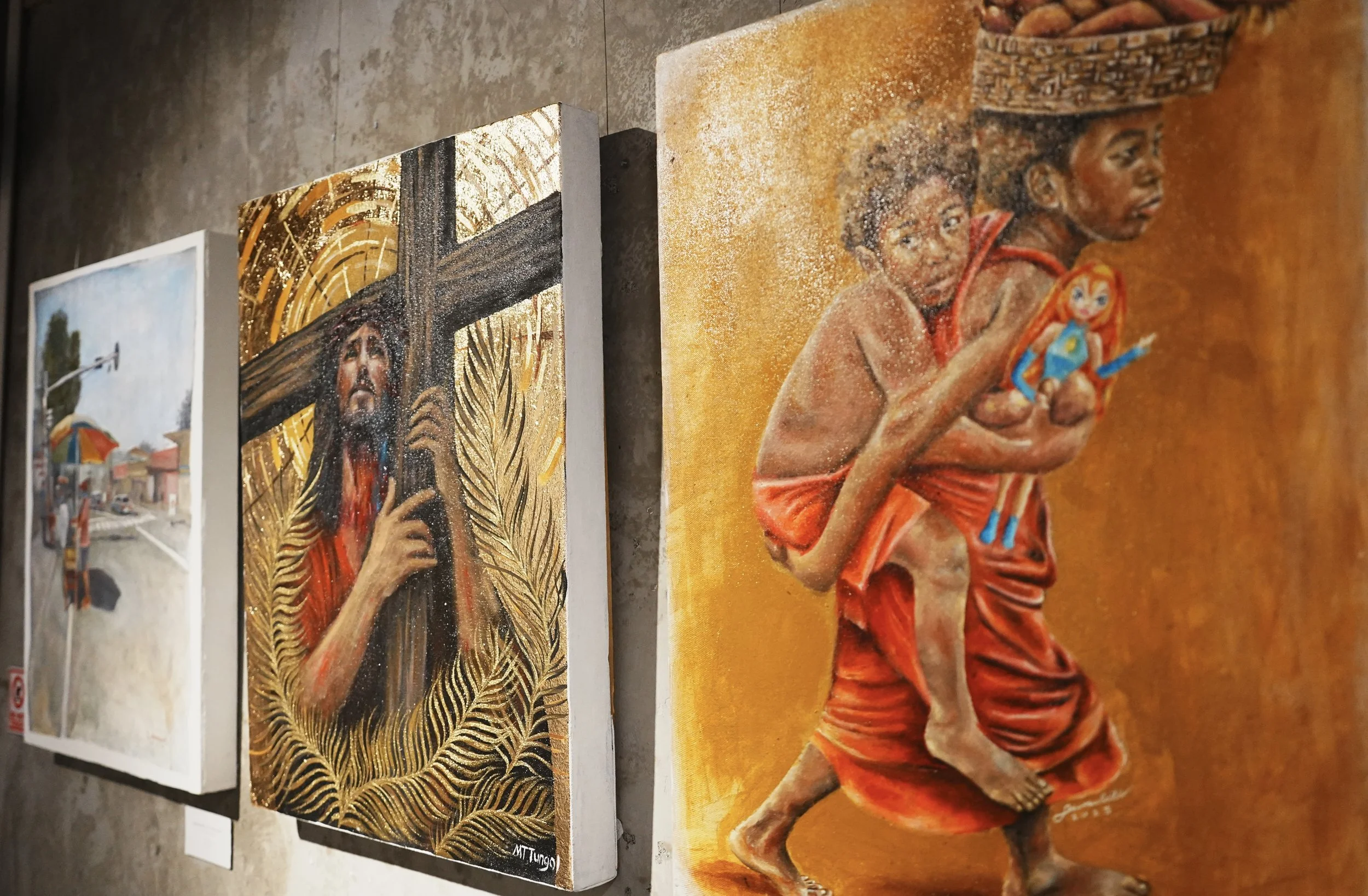
Here, identity is articulated through gesture rather than proclamation. These images recall Frantz Fanon’s insights into the lived body as the terrain upon which history, race, and subjectivity are inscribed (Black Skin, White Masks, 1952). Yet the exhibition moves beyond trauma-centered readings:
Such images foreground identity as something materially experienced rather than abstractly defined. Elsewhere, identity destabilizes. Abstraction, too, operates as a critical strategy. Fluid pigments, layered textures, and nonfigurative surfaces disrupt representational certainty. As Édouard Glissant reminds us, opacity is not a deficit but a condition of relational identity (Poetics of Relation, 1990). The refusal of full legibility becomes an assertion of autonomy against regimes that demand transparency.
Religious iconography and childhood imagery also surface intermittently, revealing the entanglement of belief, innocence, ideology, and memory within the formation of the self. These references do not resolve into singular meanings; instead, they expose identity as a contested space — where personal narrative intersects with collective mythologies.
Positioned at the exhibition’s core, the polyhedral sculpture operates as a spatial and psychic anchor. Its shifting reflections implicate both viewer and artwork within a shared field of perception. Like the Freudian “id” itself, it remains anterior to representation: a field of latent energies from which the exhibition’s multiplicity of identities appears to emerge.
Together, these aesthetic strategies reflect what Achille Mbembe describes as the “time of entanglement” — where past and present cohabit within postcolonial experience (On the Postcolony, 2001). Importantly, the exhibition does not propose heritage as stable tradition. Rather, heritage appears as something continuously reworked: fractured by modernity, reshaped by urbanization, mediated by consumption, and reimagined through artistic practice. The works collectively articulate identity as a field of tension between memory and contemporaneity, locality and globalization, inheritance and invention.
What emerges is not a singular narrative of ethnicity or belonging, but a multiplicity of positions:
Identity as labor.
Identity as memory.
Identity as performance.
Identity as fracture.
Identity as persistence.
By situating shared heritage alongside divergent artistic expressions, the exhibition rejects homogenizing narratives of ethnicity. Instead, it affirms multiplicity — identity as difference within relation.
Not merely who we are. But how we become recognizable — to ourselves and to others — within structures that precede us.
Featured Artists:
Jessica Julia Cariño
Lloyd Dacayanan
Diffix
Jeffrey Gabatin
Gerald Gloton
Gold
Manuel Trinidad Madrid
Catherine Gantan-Niwane
Chelssie Pan
Chris Pan
Camille Pingul
May Ann Reyes
Ron Salazar
Art Sumalde
Jascha Tolentino
Marinel Tungol
Curation and Text by Chan Alvarez
Works cited:
Bourdieu, Pierre. Outline of a Theory of Practice. Translated by Richard Nice. Cambridge: Cambridge University Press, 1977 (original work published 1972).
Fanon, Frantz. Black Skin, White Masks. Translated by Charles Lam Markmann. New York: Grove Press, 1967 (original work published 1952).
Freud, Sigmund. The Ego and the Id. Translated by Joan Riviere. New York: W.W. Norton & Company, 1960 (original work published 1923).
Glissant, Édouard. Poetics of Relation. Translated by Betsy Wing. Ann Arbor: University of Michigan Press, 1997 (original work published 1990).
Hall, Stuart. “Cultural Identity and Diaspora.” In Identity: Community, Culture, Difference, edited by Jonathan Rutherford, 222–237. London: Lawrence & Wishart, 1990.
Lefebvre, Henri. The Production of Space. Translated by Donald Nicholson-Smith. Oxford: Blackwell, 1991 (original work published 1974).
Mbembe, Achille. On the Postcolony. Berkeley: University of California Press, 2001.